Practices
- Touch check
- Settle
- Find your breathing pace
- Resonance breathing
- Evening unwind
Designed Kickstarter coming soon
Biofeedback instrument + app
Rest your palms on the lid and watch your heartbeat, skin and warmth come alive. Nothing to wear, nothing to stick on.
Where Octum is today
Not a medical device. A wellness product
Measured is measured. Tradition is tradition
Your data. Exportable and deletable
The idea
Your heart, breath, skin and brain each run at their own frequency. Octum is a biofeedback instrument: it reads them through a lid you touch and a few optional straps.
You don’t have to guess what your body is doing. You can watch it, notice it, and learn your own patterns over time.
Illustrative traces, not real data
How it works
Rest both hands on the gold plate. No straps, no gel: just your hands.
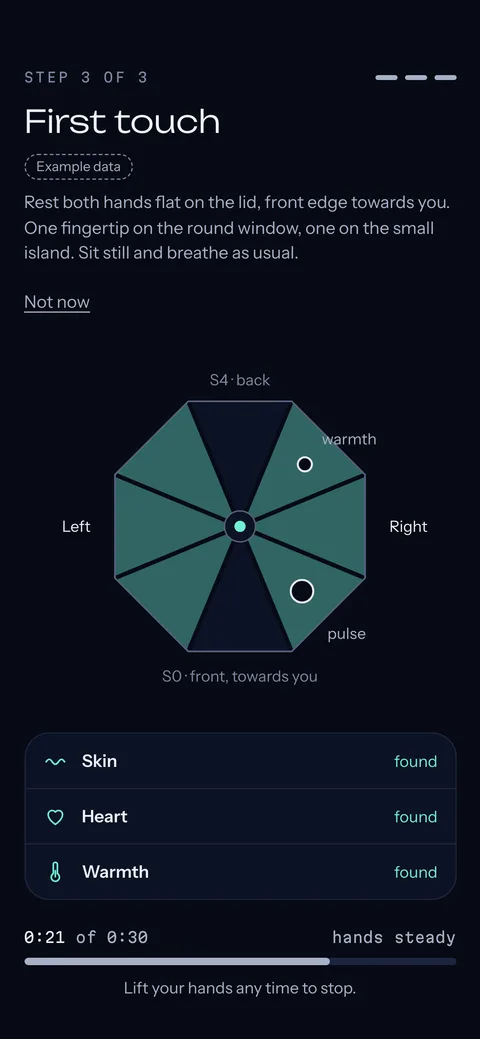
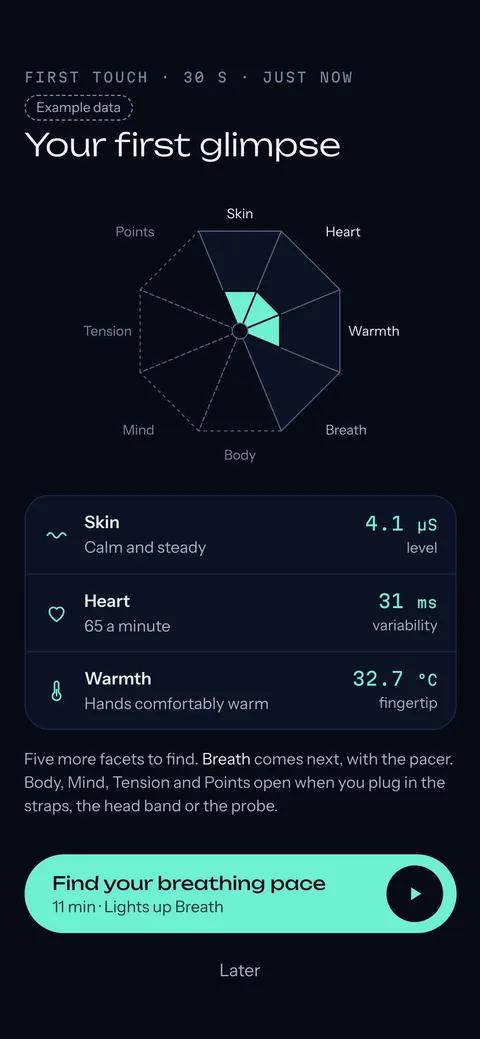
Skin, heart and warmth appear in the app: your starting point, in your own numbers.
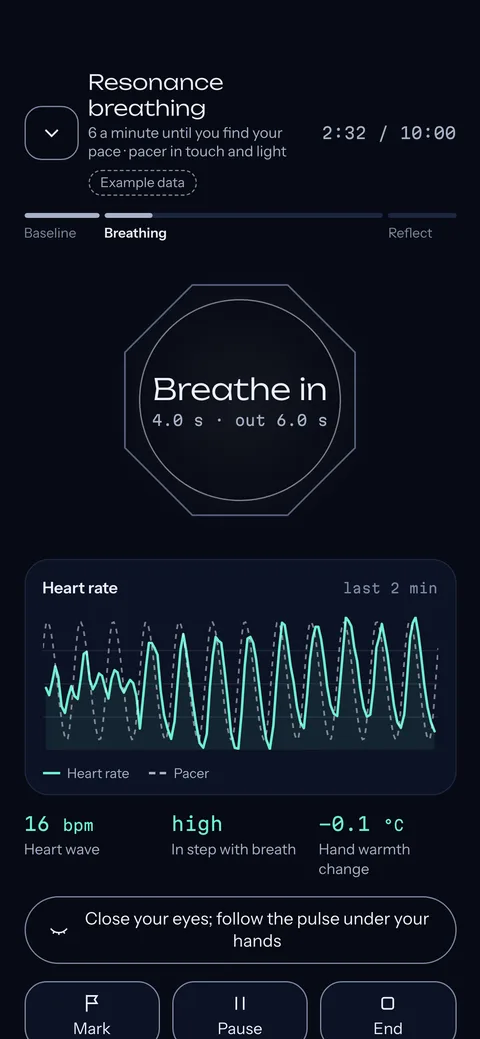
Practices that follow you, like finding your own breathing pace and then breathing with it.
Your usual
Everyone is different, so Octum learns you. From your own touches it finds your usual range for heart, skin, warmth and breath, then lets you know when you’ve been outside it for a few days. You notice changes early, and you decide what to do with them.
A handful of short touches over a few days is enough for Octum to sketch your own range for each signal, and it sharpens as you go.
When most of your readings have sat outside your usual for a few days, you get a quiet note in the app. Never a scare, and always you compared with you.
Each note comes with a practice to try and a place to jot down why: travel, a late night, a new job. If a change lasts, talking it over with a doctor may help, and you can bring your Octum report.
Octum only ever compares you with you. It can tell you that something changed, never why.
Your usual range, the change notes and your Octum report are all in the app today.
The octagon
The octagon is how Octum shows what you’ve discovered. Four facets open with the lid alone, four more with accessories. Choose one to see what it measures.
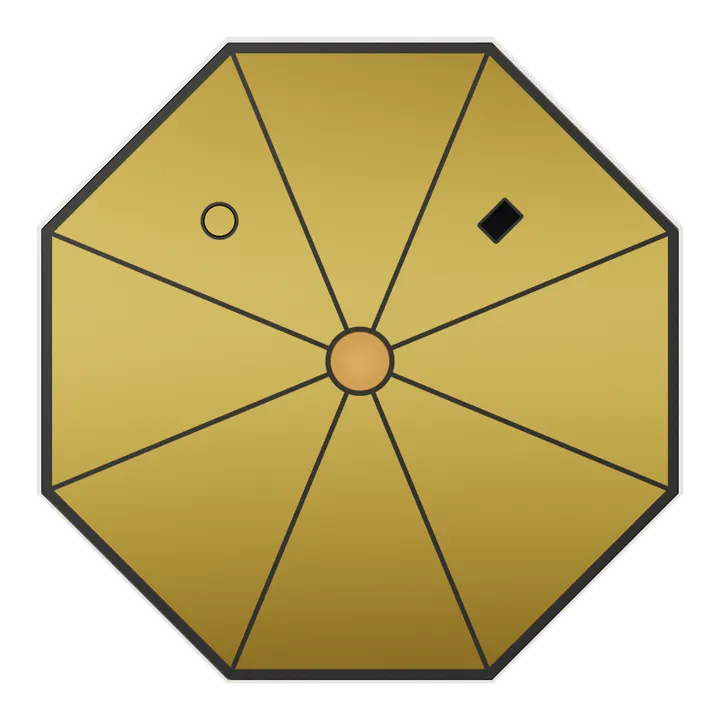
Rendering · the facets drawn over Octum’s lid Rendering · the lid from above
Facet 1 of 8 · Lid alone
How your skin responds right now, and how quickly it settles.
Facet 2 of 8 · Lid alone
Your heart’s rhythm, and how flexible it is from beat to beat.
Facet 3 of 8 · Lid alone
How warm your fingertips are, and how that changes as you practise.
Facet 4 of 8 · Lid alone
How you breathe, and the breathing pace that is your own.
Facet 5 of 8 · Needs: Limb straps · implant lock off
How your tissue responds across frequencies, segment by segment.
Facet 6 of 8 · Needs: Headband
Your brain’s rhythms, eyes open and eyes closed.
Facet 7 of 8 · Needs: Headband or ExG lead
How much tension a muscle is holding: your forehead and jaw, or any muscle you choose.
Facet 8 of 8 · Needs: Point probe · implant lock off
Skin conductance at the spots you choose, read the same way every time.
The app
Your body speaks in rhythms. Octum lets you see them, one facet at a time, in an app that grows with what you find.
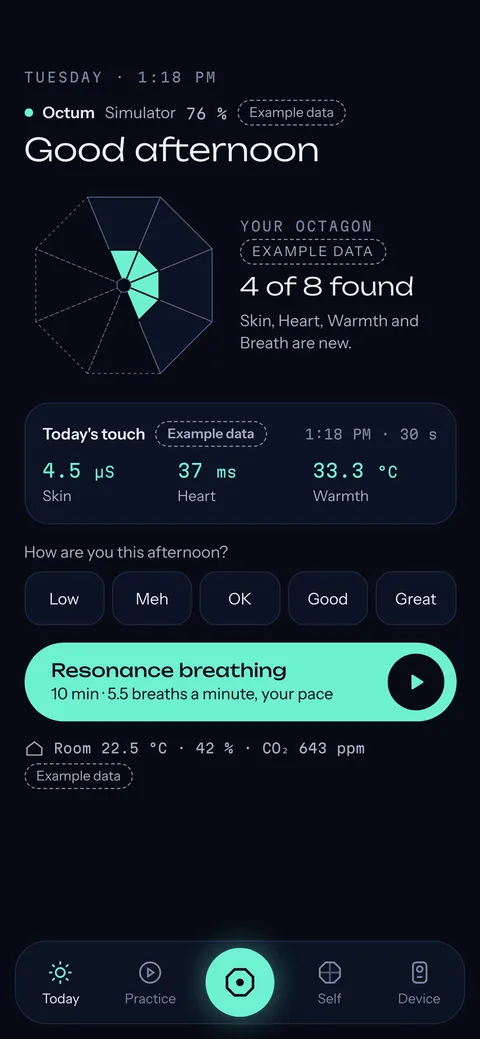
01 Today
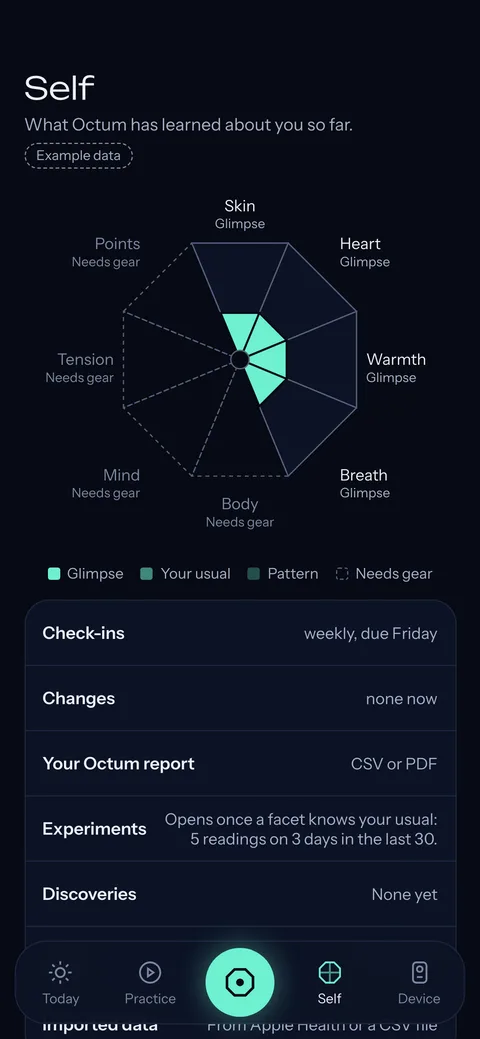
02 Self
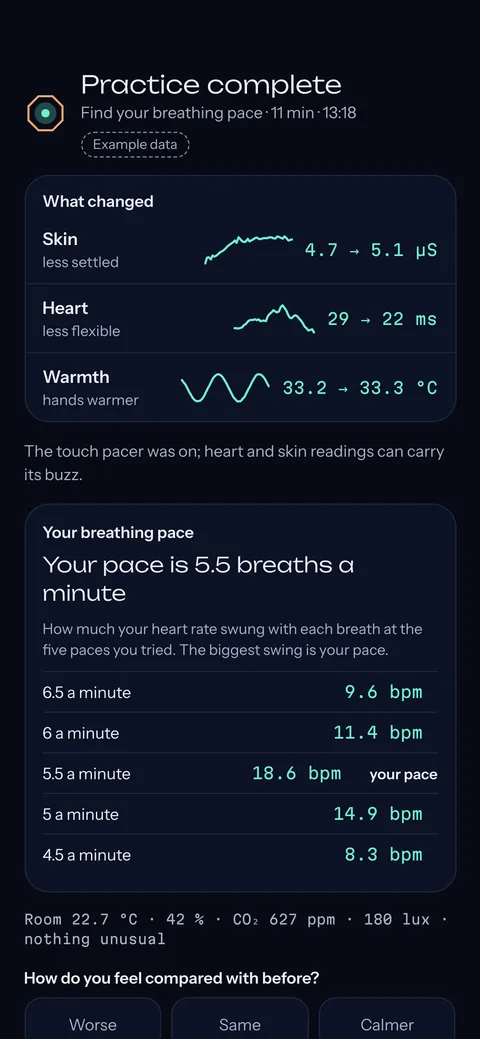
03 Reflect
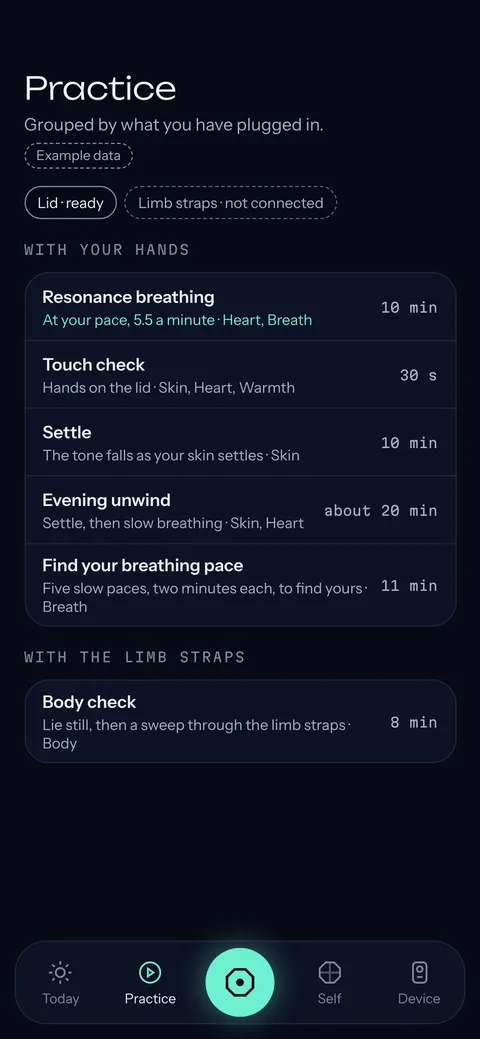
04 Practice
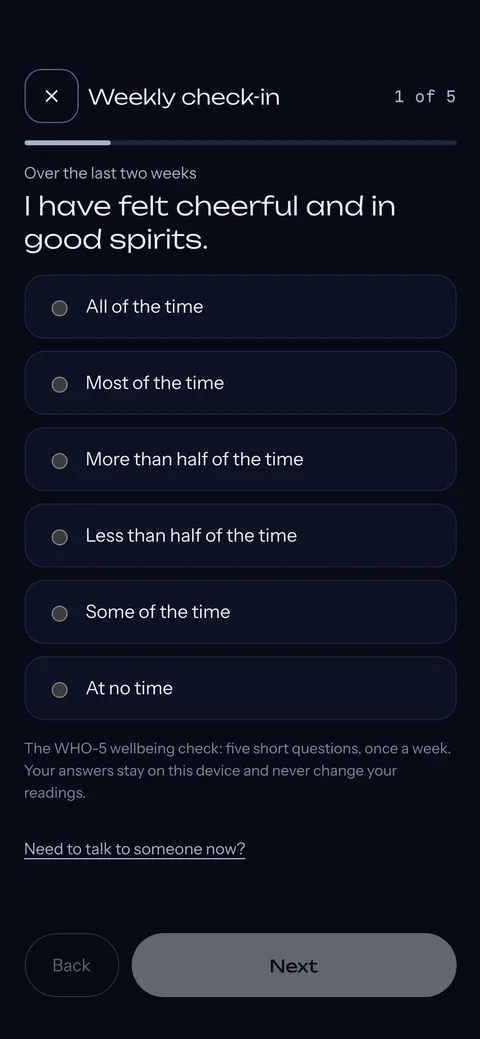
05 Weekly check-in
Five short questions, once a week. Your answers stay on your device and never change your readings. Help is one tap away.
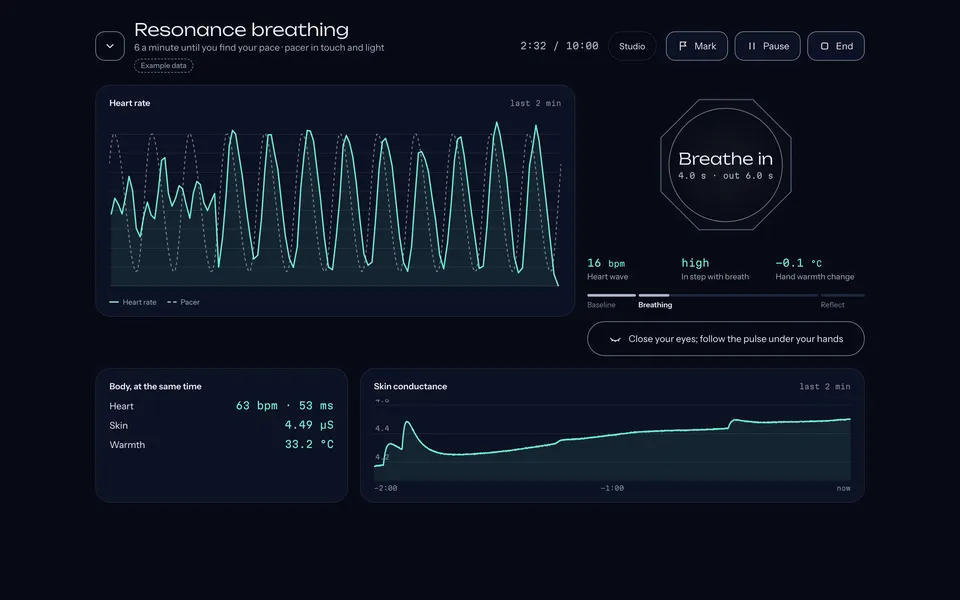
Follow the pacer by light, tone or touch. Breathe in as the pulse under your hands grows, out as it fades.
A minute with Octum
The ring grows for four seconds as you breathe in, and shrinks for six as you breathe out.
This is the pacer Octum shows on its lid, here at six breaths a minute. Close your eyes, and the lid’s haptic pulse keeps the same time.
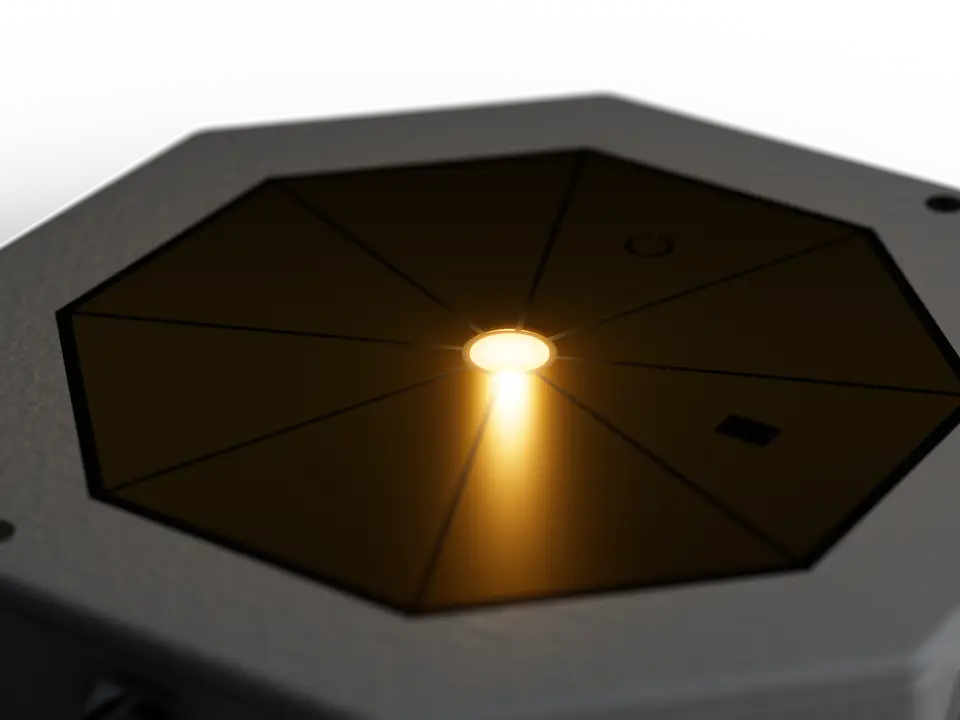
Rendering of the lid’s centre light. The ring is a demonstration, not a measurement. Rendering · a demonstration, not a measurement
The device
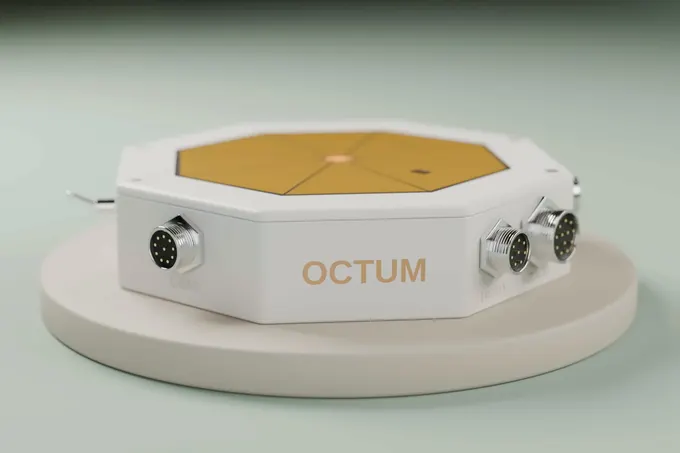
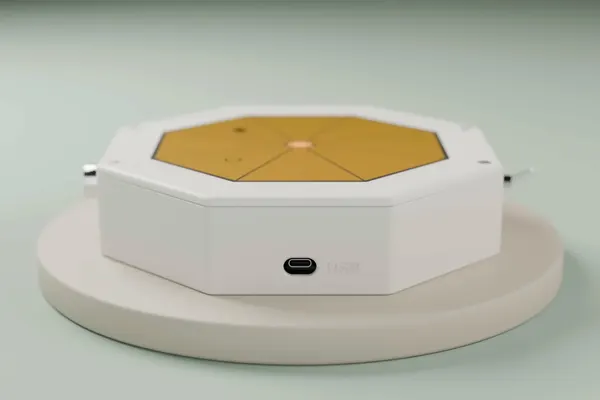
Octum is an octagon you rest your hands on. A gold touch plate on top, a soft light in the middle, and everything else out of the way.
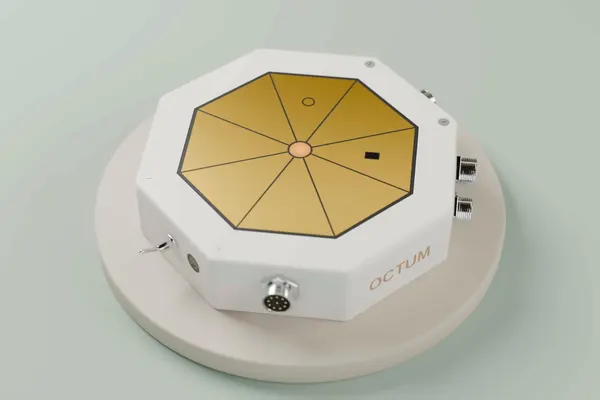
The rules live in the hardware and the firmware, not only in the app.
On by default. Turning it off asks about implants, then needs a touch on the lid’s front and back edges together.
The USB port sits behind an isolation barrier, separating a plugged-in computer from the parts that touch you.
Turning a safety setting off needs your hands on the lid: a deliberate, physical yes.
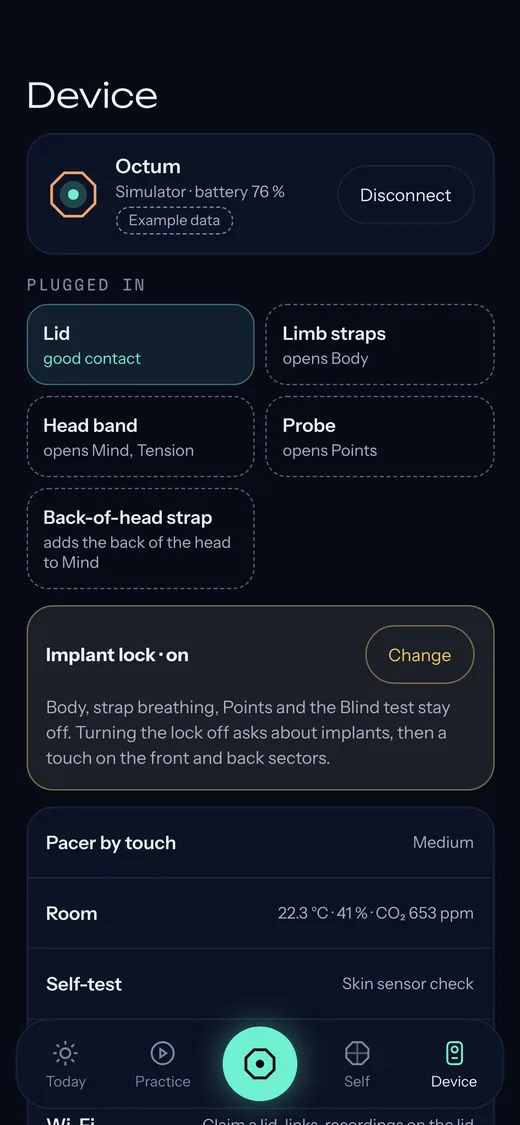
All six boards and the shell are designed. No unit has been built yet: the hardware review gate is still open, and the first units follow the Kickstarter.
Out of the box
Rest both hands on the lid and Octum starts getting to know you: no straps, no gel, nothing to put on. Everything here works from day one, with the lid alone. Touch it most days and it learns what’s usual for you.
Your heartbeat by ECG through your hands, and how its rhythm varies from beat to beat.
Your breathing rhythm, estimated from your heart rhythm, with nothing around your chest.
Skin conductance under your fingers, changing moment to moment.
Your fingertip temperature, second by second.
Guided practices paced by the lid’s light and a gentle vibration you can follow with your eyes closed.
The accessories are optional extras, for when you want to discover more.
Optional accessories
Skin, heart, warmth and breath work with the lid alone. Each accessory is optional: it plugs into a port on the shell and adds what it reads. Every Octum has all the ports, the HEAD2 socket included, so any accessory fits any Octum, at any time. They are designed and shown here as renderings; none is built yet.
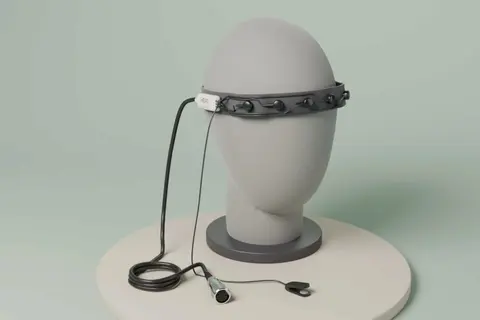
Frontal EEG at four points, and forehead and jaw tension (EMG), with an ear-clip reference.
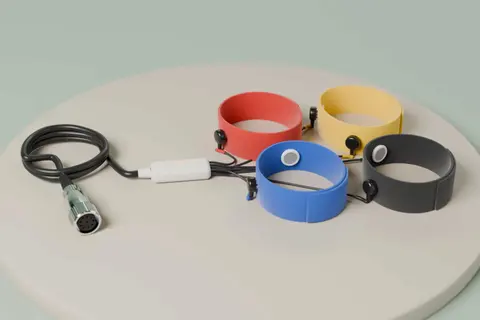
ECG from your limbs, bioimpedance spectroscopy across arms, legs and trunk, and impedance breathing at the wrists.
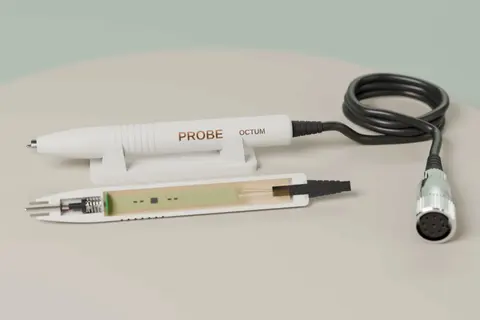
Skin conductance at a point you choose, always at the same pressure, with tilt sensing.
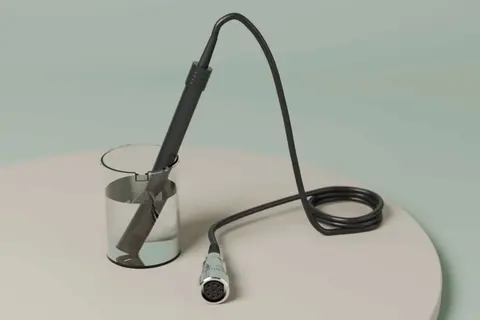
The electrical conductivity of a liquid, such as a sample in a beaker. It reads liquids, not your body.
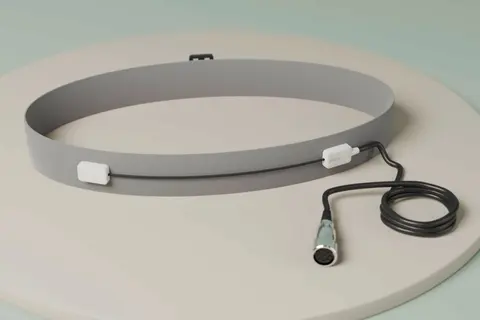
Your breathing, from the stretch of a conductive-rubber cord on a belt.
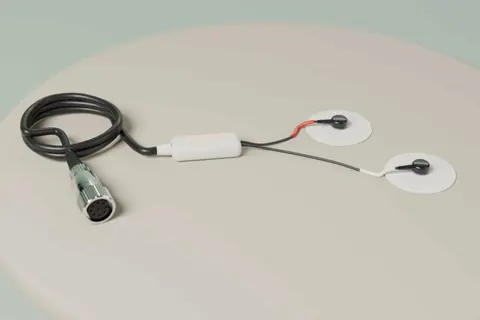
Muscle activity (EMG) or eye movement (EOG) between two gel electrodes. Measurement only.
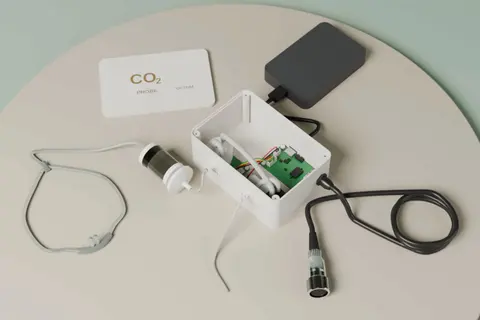
Exhaled CO2, breath by breath, sampled through a nasal cannula 20 times a second. For adults only, with its own power supply.
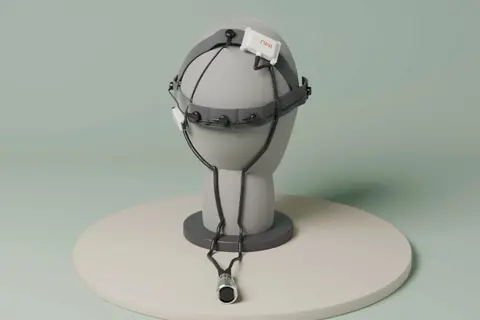
EEG at the back and sides of the head (O1, Oz, O2, Pz, T7, T8), and head motion.
Honesty
Measured
Example data
33.3°C
In the app, aqua means measured: every aqua number and trace is a reading Octum took from you, with its unit. Skin conductance, heart rhythm, warmth, breath and, with accessories, EEG, muscle activity and bioimpedance.
Tradition
Traditional maps such as meridians and chakras come later, and so does the optional Lens (Human Design, astrology). They are always labelled as tradition, never as measurement, and they never drive advice.
Measured is measured. Tradition is tradition. You always know which one you’re looking at.
Pricing
The prices we plan today, so you know before you join the list. Nothing is for sale yet.
Planned price
€999
incl. VAT
The lid with every port, the HEAD2 module, room sensing, a USB-C cable and the app.
Planned early-backer price
€749
incl. VAT
For people who back Octum in the Kickstarter campaign. The rewards are set when the campaign opens.
Optional membership
€69 a year
incl. VAT
Plus adds sync across your devices, patterns over months, discoveries across signals and an Octum report you can share. Anything that uses our EU server runs only with your consent.
Planned prices in euros. They can change before launch; the price that counts is the one shown when you back or buy. Accessory prices come later.
Kickstarter
Coming soon on Kickstarter. The list hears first when the campaign opens. Early backers will be first in line for the first units, at the planned early-backer price, and rewards will be announced at launch.
Where Octum is today
Designed (done)
All six boards and the shell.
Hardware review (in progress)
Open. No unit has been built yet.
Kickstarter (next)
Coming soon. No date yet.
First units (next)
After the campaign, to early backers first.
FAQ
The short, honest version of what people ask first.
No. Octum is a wellness product, not a medical device. It shows you your own signals so you can see, notice and learn, and it only ever compares you with your own usual. It does not diagnose anything, it can’t tell you why something changed, and nothing it shows is medical advice. If a change lasts, talking it over with a doctor may help.
Octum tells you when you are different from your own usual, not whether something is wrong. It learns your usual range from your own readings and lets you know when you’ve been outside it for a few days. It can’t tell you why a change happened, and it never names a cause. If a change lasts, talking it over with a doctor may help, and you can bring your Octum report.
After the Kickstarter campaign. Octum is fully designed, but the first units have not been built yet, so there is no shipping date. Join the list and you will hear the moment there is one.
The planned price of Octum is €999 (incl. VAT). Kickstarter backers get a planned early-backer price of €749. Octum Plus is an optional membership, at €69 a year. These prices can change before launch; the price that counts is the one shown when you back or buy.
Skin conductance (EDA), heart rhythm and heart-rate variability from ECG, an optical pulse, fingertip temperature and breathing. With accessories: frontal EEG, forehead and jaw tension (EMG) from the headband, muscle activity (EMG) from the ExG lead, bioimpedance spectroscopy across body segments and point skin conductance. With the posterior strap on the HEAD2 socket: EEG at the back of the head and head motion; with the CO2 capnometer: exhaled CO2. Every Octum also senses the room (temperature, humidity, CO2 and light), as context only.
No. The lid alone gives you skin, heart, warmth and breath. The limb straps, the headband, the point probe, the conductivity cell, the breathing belt, the ExG lead, the posterior strap and the capnometer are optional accessories that open the other facets or add detail. Every Octum has the ports for all of them, so you can add one at any time.
Yes. The Octum app runs in your browser, on iPhone, Android or a computer, and you add it to your home screen from there: there is nothing else to install. On iPhone, Octum links over Wi-Fi. On a computer, in Chrome or Edge, you can also use the USB cable, the reference link for the finest recordings.
Yes. The app has a built-in simulator, so it runs without the device. The link appears here as soon as the app is hosted.
Your data is yours. Your readings stay on your phone or computer unless you choose otherwise: an account, syncing and a live link through Octum’s server are all optional, each with its own consent, and what you sync is stored in the EU. You can export everything and delete it at any time. The full privacy details will be published before launch.
Safety is designed in. The implant lock is on by default; turning it off asks about implants and then needs your hands on the front and back edges of the lid together. The USB port is isolated, a stimulus path that exists only for blind experiments is capped in hardware, and the firmware enforces the rules. Octum hasn’t been built yet, so none of this has been tested on real hardware yet.
With the implant lock on, which is the default, skin, heart, warmth, breathing from your heart rhythm, mind and tension all work. Body, strap breathing, Points and the blind test stay off, because they send a small current through the body. If you have an implanted electronic device, keep the lock on and ask your doctor before using Octum.
Octum is designed and made by One-Management, which also builds the app. The company details are in the imprint.
Be the first to hear when Octum launches on Kickstarter.
Kickstarter coming soon
Notify me